Every e-commerce operator knows the support queue never shrinks on its own. You hire another agent, ticket volume grows to fill the capacity, and six months later you are back in the same position — more headcount, same backlog, same CSAT score. The treadmill keeps moving. The costs keep climbing. And the team keeps burning out on work that, if you are honest about it, does not require a human being to do.
This is the story of how one Magento apparel brand broke that cycle.
The brand — a direct-to-consumer women's apparel company based in the southeastern United States, which we will call Meridian Collective — came to GoMagic.ai in the fall of 2025 with a problem that looked familiar from the outside and felt catastrophic from the inside. They were processing approximately 4,200 support tickets per month with a team of four full-time agents and one part-time supervisor. Response times averaged 6.4 hours. Their CSAT score was sitting at 68. And their support manager had just given notice.
""We are spending more on customer service than we are on paid acquisition, and I have no idea what we are getting for it." — Meridian Collective CEO"
She was right to be concerned. What she did not know yet was how much of that spend was recoverable.
The Audit: What the Data Actually Showed
Before recommending anything, we ran a 30-day ticket audit. This is not a complicated process — it requires exporting ticket data from the helpdesk, categorizing each ticket by contact reason, and calculating the time and cost associated with each category. Most operators have never done this analysis because their helpdesk does not make it easy, and because the results are uncomfortable.
| Contact Reason | Monthly Volume | % of Total | Avg. Handle Time | Monthly Cost |
|---|---|---|---|---|
| Order status / WISMO | 1,470 | 35% | 4.2 min | $7,840 |
| Return initiation | 756 | 18% | 8.1 min | $5,880 |
| Tracking number resend | 378 | 9% | 2.8 min | $1,260 |
| FAQ / policy questions | 336 | 8% | 5.5 min | $2,240 |
| Exchange requests | 294 | 7% | 9.3 min | $2,940 |
| Shipping delay complaints | 252 | 6% | 11.2 min | $2,800 |
| Account access issues | 210 | 5% | 6.8 min | $1,680 |
| Complex escalations | 504 | 12% | 18.4 min | $7,560 |
| Total | 4,200 | 100% | — | $32,200 |
The $32,200 figure was higher than the CEO expected. She had been calculating support cost as agent salaries divided by ticket volume and arriving at approximately $5.30 per ticket. The true cost — including management overhead, platform costs, and the productivity drag from context-switching — was closer to $7.67 per ticket.
The more important number was the one in the first five rows. The top five contact reasons — order status, returns, tracking resends, FAQ questions, and exchanges — accounted for 77% of total ticket volume and 62% of total cost. Every single one of them followed a predictable resolution path that required no human judgment to execute.
"The support team was spending 62% of their time functioning as a very expensive search engine."
The Diagnosis: What Was Driving the Cost
The audit revealed three structural problems that were compounding on each other.
Problem 1: No proactive post-purchase communication. Meridian Collective's post-purchase email sequence consisted of a single order confirmation email. No fulfillment notification. No proactive shipping update. No delivery confirmation. Customers were placing orders, receiving a confirmation, and then hearing nothing for five to seven days while their package was in transit. The WISMO tickets were not a customer service problem — they were a communication gap that was generating avoidable contacts at scale.
Problem 2: No self-service infrastructure. The brand had no chatbot, no FAQ page that was actually findable, and no automated return portal. Every inquiry, regardless of complexity, entered the same queue and waited for the same agents. A customer who wanted to know the return window was waiting 6.4 hours for an answer that could have been delivered in three seconds.
Problem 3: The helpdesk was not integrated with the OMS. Meridian Collective was running Magento for their storefront and a separate helpdesk for support. The two systems did not talk to each other. When an agent received a WISMO ticket, they had to open a second browser tab, look up the order in Magento, copy the tracking number, and paste it into the reply. That four-step process was adding 2–3 minutes to every order status inquiry — time that was being paid for at $22 per hour.
None of these problems were unusual. They are the default state of most e-commerce operations that have grown faster than their infrastructure. The question was how much it was costing, and how quickly it could be fixed.
The Solution: Three Systems, Sequenced for Maximum ROI
We recommended a three-phase implementation sequenced to deliver the fastest return on investment while minimizing disruption to the existing team.
Phase 1 — Proactive Post-Purchase Sequences (Weeks 1–2)
The first and fastest intervention was building a proactive post-purchase communication sequence in Klaviyo, triggered by order status events from Magento. The sequence included five automated touchpoints: order confirmation with expected fulfillment timeline, fulfillment notification with tracking link when the order shipped, a proactive delay alert if the carrier scan showed the package was behind schedule, a delivery confirmation when the package was marked delivered, and a review request 48 hours after delivery.
This required no AI, no chatbot, and no complex integration. It was a two-week build using tools the brand already owned. The goal was to eliminate the information gap that was generating WISMO tickets before the AI layer was even deployed.
Phase 2 — AI Customer Service System (Weeks 3–6)
The second phase deployed an AI customer service layer integrated directly into Meridian Collective's helpdesk. The system was trained on the brand's complete knowledge base — return policy, sizing guide, shipping timelines, exchange process, and FAQ content — and connected via API to their Magento OMS for real-time order data access.
The AI handled four ticket types autonomously: order status inquiries (with live order data), return initiation (policy check + RMA generation), tracking number resends, and FAQ and policy questions. Tickets that fell outside these categories — complex escalations, shipping delay complaints requiring discretionary exceptions, and account access issues — were routed immediately to human agents with full context attached.
Phase 3 — Agent Assist and Reporting (Weeks 7–10)
The third phase layered in agent assist tools for the tickets that did reach human agents. The system surfaced relevant knowledge base articles, previous customer interactions, and suggested response templates in real time as agents were composing replies. It also automated after-ticket documentation — categorizing tickets, updating customer records, and flagging patterns for the monthly performance review.
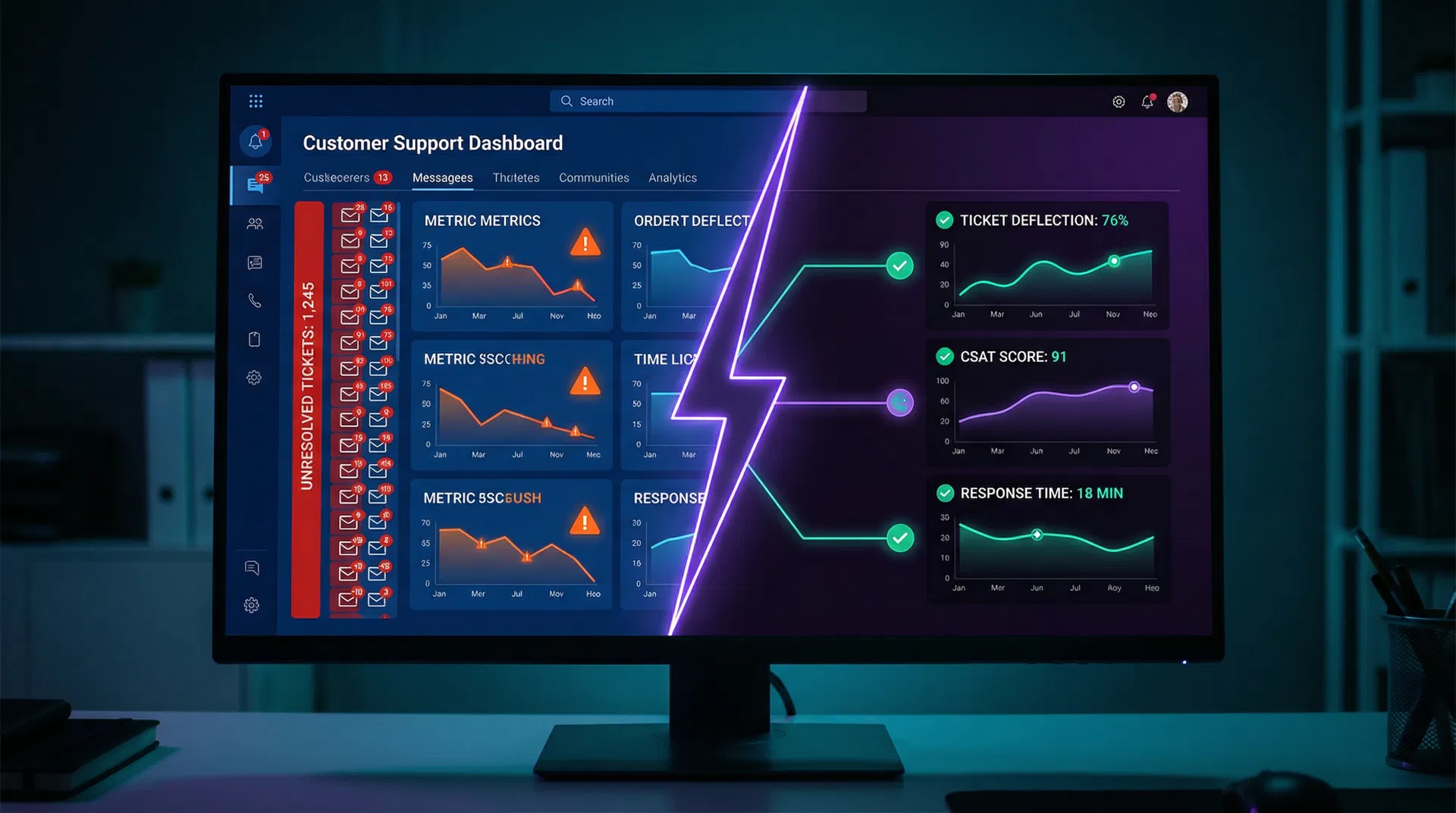
The final deliverable was a monthly performance dashboard showing ticket volume by category, deflection rate by ticket type, average handle time, CSAT by channel, and cost per resolution. This gave the CEO the visibility she had been missing — not just what support was costing, but what it was delivering.
The Results: 90 Days Later
The 90-day results were measured against the pre-implementation baseline from the audit.
| Metric | Before | After | Change |
|---|---|---|---|
| Monthly ticket volume | 4,200 | 2,310 | −45% |
| AI-resolved tickets | 0 | 1,764 | — |
| Human-handled tickets | 4,200 | 546 | −87% |
| Average response time | 6.4 hours | 18 minutes | −95% |
| CSAT score | 68 | 91 | +23 points |
| Monthly support cost | $32,200 | $12,240 | −62% |
| Cost per ticket | $7.67 | $2.91 | −62% |
The 45% reduction in total ticket volume came primarily from the proactive post-purchase sequences. WISMO tickets dropped from 1,470 per month to 420 — a 71% reduction — within the first 30 days, before the AI system was even fully deployed. Customers who received proactive shipping updates simply did not need to ask where their order was.
The AI system handled 76% of the tickets that did arrive — 1,764 per month — at an average cost of $0.94 per resolution. The remaining 546 tickets per month that reached human agents were the complex escalations, the exception requests, and the high-emotion contacts that genuinely required human judgment. The support team went from four full-time agents to two, with the two remaining agents spending their time on work that actually required them.
The CSAT improvement from 68 to 91 was the result that surprised the CEO most. She had expected cost savings. She had not expected customers to be more satisfied with an AI-first experience than with a human-first one. The explanation is straightforward: customers do not care whether a human or a machine answers their question. They care how long they wait and whether their question gets answered correctly. An 18-minute average response time with a 94% first-contact resolution rate produces better satisfaction scores than a 6.4-hour response time with a 78% first-contact resolution rate, regardless of who is doing the answering.
The Numbers: What the Investment Looked Like
The total investment for the three-phase implementation was $8,500 in setup fees, covering the post-purchase sequence build, the AI system deployment and integration, the knowledge base development, and the agent assist configuration. The ongoing management retainer is $1,500 per month, covering system monitoring, knowledge base updates, monthly performance reporting, and continuous optimization.
The monthly savings against the pre-implementation baseline are $19,960 per month ($32,200 − $12,240). The payback period on the setup fee was 13 days. The annualized net return — savings minus retainer — is $222,720 per year.
""I used to dread opening the support dashboard. Now it is one of the first things I look at every morning, because it tells me something useful." — Meridian Collective CEO, 90 days post-implementation"
That is what the right automation does. It does not just reduce costs — it converts a cost center into an intelligence asset.
What Made This Work (And What Would Have Broken It)
Three factors made this implementation successful that are worth naming explicitly, because they are not guaranteed in every engagement.
Clean data. Meridian Collective's Magento OMS had accurate, real-time order data. The AI system's ability to answer order status questions correctly depended entirely on the accuracy of the data it was querying. Operations with stale or inconsistent order data will see significantly lower deflection rates on WISMO inquiries until the data quality is addressed.
A well-documented return policy. The brand had a clear, consistently applied return policy that was already written down. The AI system was trained on that policy and could apply it accurately. Operations with inconsistent or exception-heavy policies — where agents frequently make discretionary calls — will need to standardize their policies before AI can apply them reliably.
Leadership buy-in on the transition. The CEO and support manager understood from the beginning that the goal was not to eliminate the support team — it was to redirect the team toward higher-value work. The two agents who remained after the transition were given expanded responsibilities in customer retention and VIP account management. The transition was framed as a promotion, not a reduction. That framing matters for team morale and for the quality of the human-handled tickets that the AI escalates.
Is Your Operation Ready for This?
The Meridian Collective engagement is representative of what is achievable for a mid-size e-commerce brand with the right data infrastructure and a willingness to let the numbers drive the decisions. It is not representative of every engagement — some operations have messier data, more complex policies, or more entrenched processes that require more time to address before AI can perform at this level.
The way to find out where your operation stands is to run the same audit we ran for Meridian Collective. Pull your last 90 days of ticket data. Categorize it by contact reason. Calculate your true cost per ticket. Identify what percentage of your volume follows a predictable resolution path. That analysis will tell you more about your automation opportunity than any vendor's sales pitch.
If you want someone to run that analysis for you — and deliver a written ROI projection within 48 hours — that is exactly what GoMagic.ai's free AI audit is designed to do. We will tell you what is automatable, what it will cost, and what it will return. If the numbers do not make sense for your operation, we will tell you that too.
The support queue is not going to shrink on its own. But it does not have to keep growing either.